
Council of General Synod Highlights
From the June 12th to 14th Meeting
~ from three posts on The Anglican Church of Canada website
Members of Council of General Synod (CoGS) gathered at the Queen of Apostles Renewal Centre in Mississauga, Ontario from June 12 – 14, 2026. The following information is some of what is included in the highlights of each day that have been reported on The Anglican Church of Canada’s website.
June 12th
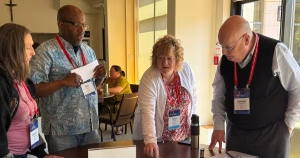
Council of General Synod members discuss ranking priorities related to the first of six transformational pathways for change in the church. Photo: Saskia Rowley
Opening Eucharist
Archbishop Shane Parker, Primate of the Anglican Church of Canada, presided and Archbishop Chris Harper, Presiding Elder of Sacred Circle, delivered the homily at the opening worship and Eucharist in the chapel.
Revisiting: Needs, Expectations and Mandate
Archdeacon Rhonda Waters, co-chair of the Planning and Agenda Team, reminded CoGS of its mandate. Council reviewed the needs and expectations, identified at their last meeting in November 2025, of voting members, partners, media and Church House staff.
Primate’s Opening Remarks
Parker recounted events since General Synod 2025, when he was elected Primate. At that meeting, more than 90 per cent of General Synod members had approved the pathways for change recommended by the Primate’s Commission on Proclaiming the Gospel in the 21stCentury, based on extensive consultation, and allocated $2 million to implement them. “It is not a business-as-usual triennium,” the Primate said. In his conversations with officers of General Synod, he said, three major pillars of work had emerged: property, Church House, and implementing the pathways.
The Anglican Church of Canada is in a period of cultural change, Parker said, in which everything must be predicated on thinking and acting differently to carry out change. He described actual, accomplished changes, as well as areas that are aspirational or need further work. The church’s national office known as Church House has made staffing changes and clarified its work, he said, reflecting the expressed desire of General Synod for a national office that costs less and acts differently.
Church House is now more focused on functions typical of a provincial office within the worldwide Anglican Communion, the Primate said, noting that very few provinces have large bureaucracies. The Anglican Church of Canada is one of two provinces where the Primate is not a diocesan bishop, he added, though that could change in the future. Relational work is a key focus of Church House, Parker said.
The Primate cited Indigenous ministries and communications as examples of major shifts in how Church House operates. Rather than an Indigenous Ministries department, the national church will now house an Office of Sacred Circle, which remains under the financial and legal umbrella of the Anglican Church of Canada but as far as possible is autonomous and guided by the Anglican Council of Indigenous Peoples (ACIP). Parker also detailed a closer relationship between communications and development and said CoGS would hear about planned changes to the church’s communication mandate, which he fully supported.
Parker pointed to actual change regarding the property pillar. The church has made further progress in negotiating its exit from a lease that would have seen Church House move from its current Toronto location of 80 Hayden Street to 300 Bloor Street West. Work is being done to optimize and monetize its current space at 80 Hayden so the resulting revenue can largely cover the cost of operations of the national office. He added that this would have the effect of lowering expectations on dioceses to fund those operations through proportional giving.
Regarding implementation of the pathways, Parker noted that change will need to happen in ways work commissioned or required by General Synod is done. Future changes might include projects having their own self-contained budgets, given lack of desire to fund a large church bureaucracy.
Parker laid out a scenario for ongoing work of CoGS over the 2025-2028 triennium, with the council currently in Year Two:
- Year One (2025/6)—Work to achieve results in three pillars is undertaken by CoGS and its transformation and property task forces, with Church House.
- Year Two (2026/7)—Work to achieve results in three pillars continues. Begin to evaluate and assess what can be accomplished in this triennium.
- Year Three (2027/8)—Work wraps up and new triennial priorities or projects are determined, to be approved by CoGS for adoption by General Synod 2028.
The Primate expressed hope that General Synod would adopt a triennial strategic cycle as its modus operandi going forward. While the church can be guided by its five transformational commitments, he said, its strategic direction needed to be more focused and disciplined.
Archdeacon Jordan Haynie Ware, clergy member for the ecclesiastical province of Northern Lights, asked the Primate how CoGS could balance General Synod’s desire to cut costs with providing services Anglicans expect, drawing a comparison to municipal budgets. Parker said church governance bodies would need to consider this question, but that General Synod would ultimately determine what it wants in its national office. Many Anglicans across the church are organizing themselves to do valuable ministry, he added, offering the example of Anglican Deacons Canada and the Refugee Sponsorship Network.
Moving on to the primacy, Parker said the work of the Primate is highly relational, interactive and representational. Visits to dioceses are a critical part of the job of Primate, he said, both in bringing an expression of the national church to local churches and in understanding the large body the Primate is called to guide and lead.
In his travels to dioceses since 2025, Parker said he had heard two major themes from Anglicans: people want to love their church, and they want to have hope. The Primate’s support for changes in the mandate for the national church’s Communications function reflected the need, he said, to tell stories about the church in a way that is regular, strategic, inclusive and accurate. “There is incredible ministry happening across our church,” he said, which needed to guide the church’s reporting and communication.
Pillars of Change
Janet Marshall and Andrew Stephens-Rennie, co-chairs of the Transformation Task Force, summarized to CoGS the content of each pathway and next steps in their implementation. The six pathways are:
- Pathway 1: Creating a smaller, simpler governance structure that supports the church proclaiming the Gospel more effectively in local communities.
- Pathway 2: Designing a clear, transparent and manageable structure and system (policies, procedures, processes) for the ministries and work of the church at the national level.
- Pathway 3: Shaping our governance to invite, reflect and represent our diversity in participation and decision-making.
- Pathway 4: Telling the story of the Gospel, sharing stories of our ministries, and participating in national and international conversations.
- Pathway 5: Developing our partnership as Indigenous and non-Indigenous church in ways that live our commitment to the truth and reconciliation efforts of the Anglican Church of Canada.
- Pathway 6: Updating and clarifying the identity of the Council of the North and building capacity towards financial self-sufficiency.
The first year of the triennium saw work on each pathway to achieve clarity regarding their scope and relationships, Marshall said. It had revealed timely initiatives that were ready to go, as well as the need for increased clarity and transparency. Some situations had changed, some initiatives were legislatively or structurally complex, and some would take longer than a triennium, with implementation of the pathways taking place on different timelines.
The Transformation Task Force will next identify and structure how the pathways overlap and inform each other, Marshall said, while working on major questions arising. Examples of the latter include how General Synod expresses core functions of communicating, connecting and convening; and how work of General Synod gets identified, prioritized and done. The task force will work with CoGS to assess what can be accomplished this triennium and what will extend into the next one, Marshall said.
Bible Study
Archdeacon Cheryl Palmer, chaplain to CoGS, led Bible study and gospel-based discipleship. Council members read and reflected upon Matthew 14:22-33, in which Jesus walks on water during a storm at sea before his disciples.
Pillars of Change: Church House Pillar
Offering an update on the Church House pillar, Andrea Mann, general secretary of General Synod, said, “Irreversible change has occurred at Church House.” Most people connected have been supportive and prayerful, she said. Mann agreed the changes suggest Church House is becoming like an office of the Province of Canada within the global Anglican Communion, leaving behind its model from previous decades by becoming smaller in size; more canonical and constitutional in its core functions, relational in its work and focused on synodical priorities of the Canadian church. She hoped such a Church House would be meaningful to the Anglican Communion’s efforts to decolonize its structures.
As of July 1, Church House will comprise 31 full-time and part-time staff members and two additional contract workers, Mann said. An anticipated retirement later this year will bring total staff down to 30. She described the changes as “not just a story of staff reduction, but also strategic growth and development.” The national office of General Synod was close to finalizing a memorandum of agreement with the Anglican Foundation of Canada and Alongside Hope for a shared legacy-giving office.
Pillars of Change: Property Pillar
Mann also offered an update on the Property Task Force that CoGS had established regarding the use of the national office space at 80 Hayden. The task force continued its oversight of the first phase of this process, Mann said, having hired an architectural contractor to look at Church House, rationalize environmental impact of current operations, and look at revenue opportunities. The consultant was nearing completion of the consultation process after interviews, digital spatial measuring, etc.
Pillars of Change: Pathway 4
Jamie Tomlinson, chair of the Communications Co-ordinating Committee/Pathway 4 team, and Henrieta Paukov, the national church’s communications director, gave an update on the work of Pathway 4, which is tasked with drawing up a new mandate and strategy for the national church’s Communications function. Tomlinson said the committee had looked at the state of the church’s national Communications function to assess what was working and not working, and develop a strategy moving forward.
Tomlinson presented a new three-fold mandate for the Communications function of the national church that would include corporate communications, development/fundraising communications and resources facilitation and sharing. Under this new mandate, the Anglican Journal would be the voice of the Anglican Church of Canada and part of its larger communications strategy rather than a separate journalistic enterprise. This change would ensure strategic alignment, effective risk management and responsible stewardship of resources for all communications products of the national church, including the Journal.
Members unanimously passed a motion establishing the new mandate for the national church’s Communications function.
Resolution
That the Council of the General Synod approve the new mandate for the National Church’s Communications functions described in the report of the Communications Coordinating Committee/Pathways 4 Team dated May 22, 2026 and directs the Communications Coordinating Committee to prepare revised Terms of Reference aligned with the Mandate for approval by the Council.
Pillars of Change: Pathway 5
Archdeacon Travis Enright, co-chair of ACIP, presented an update on Pathway 5 that reiterated notions of shared space; Indigenous identity based on language, land and lodge; distinctions between Canadian and traditional Indigenous models of governing; jurisdiction of the Anglican Church of Canada with rights and responsibilities at diocesan, provincial and national levels; and infrastructure of the Office of Sacred Circle as the administrative and pastoral support body of the self-determining Indigenous church. The latter office, he said, is funded by General Synod, accountable to Sacred Circle, and “governed in kinship, not jurisdiction” with representation based on regional council fires.
Pathway 5 work, Enright said, involves creating a church-to-church partnership based on a universal and mutual model, in which Sacred Circle and the Anglican Church of Canada “recognize each other as whole and complete expressions of the Gospel, sharing one baptism, one creed, and one Anglican Communion while each governing their own life, spirituality, and ministry in their own way.” Between Sacred Circle and General Synod is Pathway 5—representing a shared life that Enright called kiskinohamatowikamik, a Cree word which means “the place where we learn together.”
Next steps will involve generating dialogue, proposals and recommendations as the Pathway 5 team prepares a work plan for the balance of the triennium. Five dialogues will produce proposals and recommendations that will be brought to General Synod 2028. Topics of each dialogue will include:
- Church-to-church relationship. Develop a clear, publicly communicated understanding of church-to-church partnership: what it means for Sacred Circle and General Synod to be both independent and connected as the Anglican Church of Canada. Output: Agreed definition for General Synod 2028.
- Governance canons. Create effective governance canons that support and clearly articulate the mutual relationship between Sacred Circle and General Synod—giving the partnership canonical, structural form. Output: Proposed canon revisions for General Synod 2028.
- General Synod decision-making. Develop a new model of committee processes and decision-making for the meeting of General Synod that enables full Indigenous participation and honest conversation. Connected to pathways 1, 2 and 3. Output: New committee model for General Synod 2028.
- Communication strategy. Connected to Pathway 4. Support Sacred Circle to build an in-depth communication strategy across all dioceses, increasing awareness of the Covenant and Our Way of Life and the work of Sacred Circle. Encourage active consultation and information-sharing among bishops across the diocese and council fires. Three focus areas: Covenant and Our Way of Life literacy diocese-wide, bishop-to-bishop consultation mechanisms, Sacred Circle voice in provincial and diocesan life. Output: Diocesan communications strategy and bishop engagement framework.
- Council of the North conversation. Connected to Pathway 6. An in-depth conversation between General Synod, Sacred Circle and the Council of the North to determine how all three can move forward in a good way. This conversation informs and is done in partnership with the work of Pathway 6. Three parties at the council fire: General Synod, historic non-Indigenous church; Sacred Circle, self-determining Indigenous Church; Council of the North, northern regional ministry. Output: Agreed path forward for all three, informing Pathway 6 recommendations.
Pillars of Change: Transformation Task Force Overview
Stephens-Rennie presented a high-level overview from the Transformation Task Force on work around each of the pathways. Based on the current plan for the triennium, in year 1, CoGS and the Transformation Task Force undertake work to achieve the pathways results, supported by Church House. In year 2—where the church currently is—work continues to achieve results and CoGS establishes an evaluation and priority-setting process at mid-year. In year 3, work wraps up, an Evaluation Priority Process evaluates efforts and determines new triennial priorities, and CoGS approves priorities for final adoption by General Synod.
Evening Prayer
CoGS members concluded the day with prayer in the chapel.
An evening social took place from 8:30 to 11 p.m.
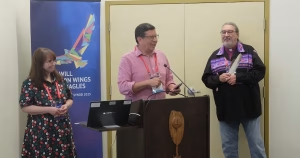
L-R: Lt.-Col. the Rev. Catherine Askew and Archdeacon Travis Enright, co-chairs of the Anglican Council of Indigenous Peoples (ACIP), and Presiding Elder of Sacred Circle Chris Harper present the ACIP report to Council of General Synod on June 13. Photo: Matthew Puddister
June 13th
Tracking CoGS Deliverables
General Secretary Andrea Mann offered updates on resolutions that General Synod had forwarded to CoGS, which she grouped into three categories. The first involved resolutions for which General Synod had requested action from CoGS. The second group of resolutions was not approved by General Synod but referred to CoGS for decision. The third group of resolutions was approved by General Synod and referred to CoGS for monitoring. (See the Highlights for June 13th on The Anglican Church of Canada website for a list of the resolutions and actions.)
Overall, work on 23 of 28 General Synod resolutions referred to CoGS was either in progress or had been delivered, Mann said. “I think that’s pretty darn good.” Work plans were in development for the remaining five resolutions, she added.
Faith, Worship, and Ministry Committee
Dion Lewis, CoGS representative and co-chair of the Faith, Worship and Ministry Committee, brought forward several motions, which CoGS passed. The resoutions concerned
- Ministry with the Sick and Dying in the Context of MAiD [medical assistance in dying];
- Ministère auprès des personnes maladies, Propres Semaine sainte et Pâques, new wording of la Prière du Seigneur (the Lord’s Prayer);
- The Bible in Public Worship;
- the Report on Liturgical Advisory Committee Surveys, with Recommendations;
- Good Friday: An Alternative Liturgy;
- the resource Behold what you are; Become what you receive: a resource for learning, discussion and reflection on the fundamental principles of liturgy in the Anglican Church of Canada;
- Emancipation Sunday: Liturgical Resources; and
- The Final Report of the Second Phase (2023-2025) of the Anglican-Mennonite Dialogue in Canada.
(See the Highlights for June 13th on The Anglican Church of Canada website for the wording of the resolutions.)
Governance Working Group
Chancellor George Cadman, chair of the Governance Working Group, clarified Resolution C001-R1, which General Synod referred to CoGS to examine all that would be necessary to modify Canon III, Part 1, 4 B, which details the primacy in the Anglican Church of Canada. The canon currently requires that as soon as practicable after election, but no more than 90 days, the primate-elect shall resign episcopal and metropolitical offices held at the time of their election to primacy. General Synod had contemplated that the primate may at their discretion retain diocesan office but would have to resign metropolitical office, Cadman said, which was referred to the Governance Working Group for analysis.
The Governance Working Group report, Cadman said, outlined three points for consideration. First, any changes would require not simply amending Canon III, but an amendment to Canon XVIII, the discipline canon. Secondly, any such amendments would not affect the primatial election at General Synod 2028, because thirdly, canonical amendments must be passed at two successive General Synods. However, Cadman noted that work of CoGS could be brought forward at a special General Synod before General Synod 2028, which could result in adoption of the change.
Council discussed and questioned the ramifications of the primate also being a diocesan bishop, which is the case in all provinces of the Anglican Communion other than Canada and the United States, opting to revisit the matter later and give members time for reflection.
2025 Audited Financial Statements
Beng Wee, treasurer of General Synod, presented the 2025 audited financial statements for General Synod and the Consolidated Trust Fund, which he described as good news. “Basically, it’s a boring report and that’s a good report in this context,” Wee said. A rise in investment outcome had mitigated loss in revenue, he said.
CoGS passed two motions approving the financial statements.
Resolution
That this Council of the General Synod approve the draft audited Consolidated Financial Statements of the General Synod of the Anglican Church of Canada as at December 31, 2025, as presented.
Resolution
That this Council of the General Synod approve the draft audited Financial Statements of the Consolidated Trust Fund of the Anglican Church of Canada as at December 31, 2025, as presented.
Bible Study
Archdeacon Cheryl Palmer, chaplain to CoGS, led council in Bible study and gospel-based discipleship. Members reflected on John 1:1-18, which introduces Jesus as the eternal Word who became human to reveal the Light of God to the world.
Anglican Council of Indigenous Peoples
Presiding Elder and National Indigenous Archbishop Chris Harper introduced the report from the Anglican Council of Indigenous Peoples (ACIP). Lt.-Col. the Rev. Catherine Askew and Archdeacon Travis Enright, co-chairs of ACIP, recounted the background over decades leading up to the establishment of Sacred Circle as the self-determining Indigenous church.
Enright described grief that Indigenous Anglicans had dealt with since the COVID-19 pandemic, with the death of many elders including the Rev. Canon Ginny Doctor, longtime Indigenous Ministries coordinator; and the 2022 resignation of Mark MacDonald as national Indigenous Anglican archbishop. “We are a people of the drum,” Enright said. Finding a new drumbeat to animate their work, he said, required honouring those who had gone before. Enright and the Rev. Canon Scott Sharman, the Anglican Church of Canada’s animator for ecumenical and interfaith relations, sang a healing song together.
Providing an overview on Sacred Circle’s representation through 12 regional council fires, Enright said Sacred Circle’s work plan for the next three years would involve clarifying governance, showing up for each other, growing their own leaders (“Indigenous leaders shaped by Indigenous communities”), developing worship that centres local Indigenous liturgy in shared worship, and building a structured financial plan with the Anglican Church of Canada that aligns finances with the other priority areas.
2026 YTD Statement
Amal Attia, chief financial officer, presented the 2026 year-to-date financial statement for General Synod. She said General Synod was moving towards a lower deficit and more diverse sources of revenue.
Refugee Network Panel
Archdeacon Bill Mous and Ishita Ghose, refugee coordinators for the dioceses of Niagara and Ottawa, respectively, gave an overview of refugee sponsorship across the Anglican Church of Canada, looking ahead to World Refugee Day on June 20.
Fifteen Anglican dioceses are sponsorship agreement holders (SAHs), established organizations that have signed a formal agreement with the Canadian government to privately sponsor refugees. Mous said that Jesus, himself a refugee, invited us to ministry that transforms lives—and that with increasing conflicts and crises, the need to resettle refugees has never been greater. Anglican sponsorship significantly increased with the Syrian refugee crisis in 2015 and 2016.
In 2026, the Canadian government significantly reduced humanitarian admissions from outside Canada. In response, the Canadian Refugee SAH Association is calling for the government to commit to welcoming at least 27,000 privately sponsored refugees in 2027. Ghose and Mous implored CoGS members to support refugee sponsorship by providing SAHs with the resources they need, encouraging parishes to participate in sponsorship, advocating nationally for the federal government to increase the refugee sponsorship cap, celebrating Refugee Sunday at any time of year by sharing stories and lifting up the work of volunteers, and partnering with non-Anglican SAHs where needed.
Terms of Reference
Prolocutor Phibbs presented motions on terms of reference for Resolution C006-R1, concerning non-disclosure and non-disparagement agreements; and the General Synod Planning Committee. Both carried.
Resolution
That the Council of the General Synod adopt the Terms of Reference for the CoGS Working Group on Non-Disclosure and Non-Disparagement Agreements.
Resolution
That the Council of the General Synod approve and adopt the Terms of Reference for the General Synod Planning Committee (GSPC), including its subcommittees, the Worship Committee, and the Local Arrangements Committee.
Nairobi-Cairo Proposals
The general secretary introduced Canon Alyson Barnett-Cowan, former director of Faith, Unity and Order for the Anglican Communion; and Sharman, who will soon transition from his current part-time role as the Anglican Church of Canada’s animator for ecumenical and interfaith relations to full-time national senior advisor on unity, faith and order. Both are members of the group currently studying proposed reforms to Anglican Communion structures, known as the Nairobi-Cairo Proposals, to inform delegates from the Anglican Church of Canada who will attend an upcoming Anglican Consultative Council (ACC) meeting in Belfast, Ireland. Delegates at the June 27-July 5 meeting will discuss and vote on whether the ACC endorses the proposals or will ask for further changes.
Barnett-Cowan and Sharman outlined the background and content of the Nairobi-Cairo Proposals, which involves two main proposals. The first proposal would change the definition of the Communion from provinces “in communion with the See of Canterbury” to provinces “in conference and connection with the See of Canterbury, by which they seek interdependently to foster the highest degree of communion possible one with another.” The second proposal initially called for a rotating presidency of the ACC, a role formerly held by the Archbishop of Canterbury; a 2026 supplement recommended eliminating the role of ACC president entirely.
CoGS members weighed in on the extent to which the Anglican Communion mattered to them; other affirmations, questions or concerns they might have about potential impact of the Nairobi-Cairo Proposals; and whether there might be any value in creating a working group to clarify Canadian Anglican perspectives at the Belfast conference. Table groups discussed and provided feedback, but CoGS did not set up a new working group related to the Nairobi-Cairo Proposals.
Members broke for a banquet dinner from 5 to 7 p.m.
Resolution C005 (Artificial Intelligence)
Ryan Weston, lead animator of Public Witness for Social and Ecological Justice, presented a review of Resolution C005, which directed CoGS to convene an artificial intelligence (AI) ethics task force, and outlined potential next steps. Discussions on AI have taken place through diocesan and ecumenical activities and conversations, Weston said, noting that the first encyclical of Pope Leo XIV deals extensively with AI.
Evening Prayer
Council held evening prayer in the chapel.
An evening social took place from 8:30 to 11 p.m.
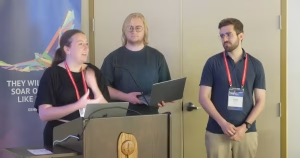
L-R: Council of General Synod members Paige Keller, Noah Skinner, and Zach Groves present terms of reference for the National Youth Council on June 14. Photo: Matthew Puddister
June 14th
National Youth Council Terms of Reference
Paige Keller, youth member for the ecclesiastical province of Ontario; Zach Groves, lay member for the ecclesiastical province of B.C. and Yukon; and Noah Skinner, lay member for the province of Ontario, reported on formation of the National Youth Council and provided background to terms of reference that CoGS would vote on.
Groves said the immediate objective was a vote to formalize the existence of, and provide binding rules for, the National Youth Council, which would build up the terms of reference further over the course of the 2025-2028 triennium, addressing concerns such as safeguarding procedures and role definition. The members put forward three motions related to the National Youth Council, which carried.
Resolution
That the Council of the General Synod adopt and approve the National Youth Council (NYC) Terms of Reference (TOR) as presented by the NYC TOR Task Force.
Resolution
That this Council of the General Synod extend the term of the National Youth Council TOR Task Force so that it may work alongside the Church House Communications function to create the NYC application portal and share it across the country, and to establish the primary email account for the National Youth Council, with this extension to continue through the launch of the open national application process.
Resolution
That this Council of the General Synod empower the General Secretary to appoint five (5) members of the Council of the General Synod to the National Youth Council Initial Appointment Review Committee (IARC), which is mandated under the National Youth Council Terms of Reference to review all initial applicants to the National Youth Council and to select and present the initial appointments to the Council of the General Synod for approval by the conclusion of the fall 2026 CoGS meeting. This committee is to be populated by the end of July 2026.
Outstanding Motions
Two clergy members for the ecclesiastical province of the Northern Lights presented motions. Archdeacon Lauren Schoeck put forward a motion on the liturgical principles document “Behold What You Are, Become What You Receive,” while Archdeacon Jordan Haynie Ware presented two motions related to artificial intelligence (AI). Both carried.
Resolution
That this Council of the General Synod request that the communications function of General Synod research and provide the costing of making available “Behold What You Are, Become What You Receive” as a physical document available for purchase and report back to Council of the General Synod’s November meeting for action.
Resolution
That this Council of the General Synod direct the Office of the Primate and General Secretary to appoint a working group to develop Terms of Reference for an Artificial Intelligence (AI) Ethics Task Force that will help the church negotiate faithful engagement as generative artificial intelligence (genAI) technologies shift and to bring these terms of reference to the November 2026 meeting of the council for adoption.
The mandate of the task force should include:
- Review existing scholarly, ecumenical, and other relevant resources as well as craft original work, as appropriate, to assist dioceses, parishes, and individual members with the job of continuing to act in a manner consistent with our baptismal covenant.
- Provide guidance related to respect for intellectual property rights, Indigenous rights, personal data protection, environmental stewardship, and other virtues espoused by the Anglican Church of Canada as they find relevant.
- Consider policies or guiding principles for genAI use by staff, standing committees, and coordinating committees to ensure any such use in a fair, transparent, and consistent manner with these principles.
- Develop methods to distribute these principles to dioceses that wish to take up their own principles and procedures to guide genAI use.
Resolution
That this Council of General Synod direct the Office of the Primate and General Secretary to adopt as an interim policy on the use of artificial intelligence a policy identical to that adopted by the Anglican Foundation, until such time as this body can receive advice from a duly appointed ethics task force on this topic.
Partner Reflections
Schoeck, representative of CoGS to the Evangelical Lutheran Church in Canada (ELCIC) National Church Council, shared her experience attending the spring meeting of the latter in Calgary. The gathering included a visit to a local Moravian church, reflecting the full communion partnership of Anglicans, Lutherans and Moravians in Canada since 2023.
Similarly to how Anglicans are discussing pathways for change, Schoeck said, Lutherans engaged in a multi-year project of planning the future of their church: Facing Today – Dreaming for the Future. She described being moved by the process as Lutherans freely shared with each other aspects they felt were going too fast or that had been left out. “It was beautiful to see that actual deep listening that was happening,” she said. The ELCIC, she added, is also engaged in discussion on AI in partnership with the United Church of Canada.
The Rev. Chris Bishopp, ELCIC representative to CoGS, spoke about the deepening connections between the Anglican Church of Canada and ELCIC ahead of the 25th anniversary of the Waterloo Declaration, which established full communion between the two churches. Under the leadership of Bishop Larry Kochendorfer, who became national bishop in 2025, Lutherans are keeping their full communion partners in mind as they navigate a process of change within their church, he said.
The Anglican Church of Canada’s developing relationship with the Indigenous church, Bishopp said, remains a source of inspiration for the ELCIC in its own relationship with Indigenous peoples. With the ELCIC also increasing work alongside the United Church of Canada, working with ecumenical partners was becoming essential to success in communicating the gospel, he said. “These are stressful times, but I think they’re also exciting times.” Bishopp looked forward to the results of ongoing work together.
Eucharist
Archbishop Shane Parker, Primate of the Anglican Church of Canada, presided and gave the homily at a closing Eucharist in the chapel.
Evaluation
Archdeacon Rhonda Waters, co-chair of the Planning and Agenda team, led council members in an evaluation of their meeting over the previous days. Table groups offered feedback on the pace and flow of the agenda, hospitality and socials, presentation and worship, and preparation materials and support.
Closing Remarks and Prayer
The Primate reminded CoGS of their unique responsibilities as individuals chosen by our four ecclesiastical provinces to be members of the supreme governing body of the Anglican Church of Canada apart from General Synod. As trustees of the church when serving on the council, he said, it is the duty of members to put forward their opinions to help CoGS make decisions—“to say what needs to be said, to say uncomfortable things, to disagree, and to speak our consciences.”
However, once council makes a decision, he said, it belongs to all members, and each one has an obligation to represent it by communicating and explaining it to others. “That is good governance,” Parker said. “It reinforces unity as we move forward.” The Primate led members in a closing prayer.
Council adjourned at 2:30 p.m.