
Ecumenical Delegation Visits Cuba
The Rev. Michael Blair, general secretary of the United Church of Canada, joins other denominational leaders and international Christian organizations visiting Cuba
~ from a post dated March 27, 2026 on the World Communion of Reformed Churches website
 A high-level international ecumenical delegation initiated by the World Communion of Reformed Churches (WCRC) will be in Havana from March 28-31, 2026, on a solidarity visit aimed at responding to the island’s deepening humanitarian crisis and growing global concern over the impact of economic sanctions on its people.
The visit comes as ecumenical organizations increasingly warn of the humanitarian consequences of long-standing sanctions and newly intensified restrictions affecting fuel supplies to Cuba. The United Nations recently announced the need for a revised plan of action on March 24, 2026, that addresses the “cascading effect on essential services such as health care, education, sanitation and the availability of food and water” and the “constraints on humanitarian operations.” The United Nations heard from its representative in Havana on March 26 that dwindling energy reserves were creating “acute humanitarian risks,” as 90% of essential services in the nation rely on oil. This includes 5 million people living with chronic illnesses whose treatments are at risk of disruption and 1 million people who rely on tanker trucks for drinking water.
The delegation consists of the WCRC general secretary, the Rev. Philip Vinod Peacock; the Rev. Prof. Dr. Jerry Pillay, general secretary of the World Council of Churches; Jihyun Oh, stated clerk of the General Assembly of the Presbyterian Church (U.S.A.) and executive director of Presbyterian Life & Witness; the Rev. Jimmie R. Hawkins, director of advocacy in the Presbyterian Church (U.S.A.); the Rt. Rev. Anthony Poggo, secretary-general of the Anglican Communion; the Rev. Michael Blair, general secretary of the United Church of Canada; and the Rev. Dr. Reynaldo Ferreira Leao Neto, general secretary of the World Methodist Council.
During the visit, the delegation will meet with Cuban churches and ecumenical leaders, government officials and local communities, focusing on the humanitarian situation, the role of churches in accompanying vulnerable communities, and the need for policies that prioritize human dignity.
The program also includes a visit to the National Institute of Oncology in Havana and participation in ecumenical gatherings and Palm Sunday worship services across the city.
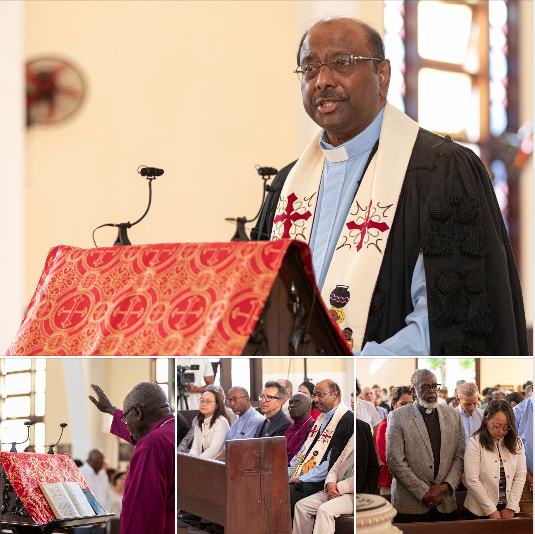
From an ecumenical service held at the Episcopal Cathedral of Havana on March 29, 2026. Photo collage from a March 30, 2026 post on the World Council of Churches Facebook page
~ from a March 30, 2026 post on the World Council of Churches Facebook page
In a powerful reflection, the World Council of Churches general secretary Rev. Prof. Dr Jerry Pillay highlighted how Cuba’s churches are offering a bold and hopeful witness — standing with communities, responding to hardship, and speaking truth in challenging times.
Pillay delivered the sermon during an ecumenical service held at the Episcopal Cathedral of Havana on 29 March.
The service took place during a visit by global ecumenical leaders expressing solidarity with the Cuban people amid ongoing internal and external challenges.
In his address, Pillay pointed to the global context of conflict and instability, noting that “a simple look at what is happening in Gaza, Ukraine, Sudan, the Democratic Republic of the Congo, Myanmar, Colombia, Iran, and many other parts of the world shows that thousands are dying, and no one seems able to stop these senseless killings.”
He underscored the failure of political leadership to halt violence and raised concerns about the erosion of respect for international law, state sovereignty, human dignity, and the sanctity of life.
Read more on the World Council of Churches website.